Your cart is currently empty!
Emily Prokop – PES 125
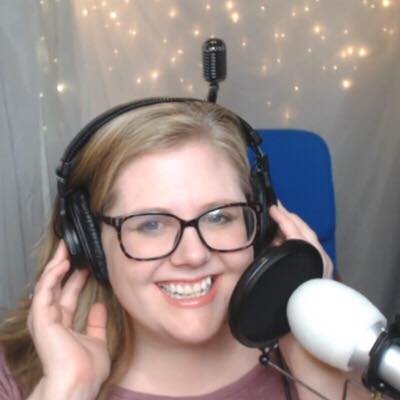
Hang out with me and Emily Prokop. She is the host of The Story Behind podcast, a podcast editor and consultant, and author of The Story Behind: The Extraordinary History Behind Ordinary Objects!
We discussed Emily’s equipment and workflow, and lots more:
- Blooper track: She copies clips onto a dedicated track for bloopers.
- Handling loud breaths: She moves all the loud breaths onto a dedicated track where she lowers their volume!
- Noise reduction
- Hi-pass filtering
- In her “studio”: Moving blankets around her desk and curtains to dampen room noise, white shears
- Reaper and Reaper templates
- iZotope RX 6: De-plosive, Mouth De-click
- ATR2100 microphone
- Sony MDR-7506 Headphones
- Publishing a 96kbps mono MP3 for her show
- Auphonic leveling to -16 LUFS (! her mono track!)
- Hardwired to internet
- Previously Emily was on Dave Jackson’s show discussing structuring and presenting good content on podcasts because she has more than 10 years editing experience in print journalism. That episode is titled Journalism 101 For Podcasters.
Thanks for sharing so much great info, Emily!
Comment below with any questions or comments.
.
Comments
6 responses to “Emily Prokop – PES 125”
-
Chris and Emily,
A few things:
When referencing an Integrated (Program) Loudness variation between two programs – you wouldn’t refer to any such variation in LUFS. LUFS represent “Loudness Units relative to Full Scale.” The correct variation reference would be in “Loudness Units” (LU’s). For example: Program (A) checks in @ -16 LUFS. Program (B) checks in @ -14 LUFS. In essence Program (B) is +2 LU louder than Program (A).
With regards to (in most cases) excessive limiting that may be necessary when targeting something like -14 LUFS/-2 dBTP … sure, if the audio is well processed and optimized before Loudness Normalization, the inherent limiting should not result in compromised fidelity. Note at this stage the Loudness Normalized audio will almost certainly exist in a lossless file format.
The issue of concern is heavily limited lossless audio may not translate well throughout further downstream lossy (MP3) encoding, especially at low bitrates. The lossy distribution file may potentially exhibit codec artifacts and/or distortion, even if the audio is not theoretically clipped.
-paul.
@produceNewMedia-
Thank you, Paul!
-
-
Did Emily already do a video of micro-editing in Reaper. It is so easy, and there’s a great macro too for removing slightly longer edits.
-
I’m not sure, Jeremy, I’ll check. I’ll ping her on Facebook – follow here: https://www.facebook.com/podcastengineeringschool/
-
-
[…] Prokop (previous guest on my show!) does this really well, and you can watch her do Live Editing on […]
-
Hey Emily, your de-breathing technique sounds like exactly what I need! I use Audition as my DAW and I tried to follow your instructions from the podcast but I can’t work out how to replicate it there. Can you help at all? Thanks!


Leave a Reply to Editing in Reaper While the Session is Playing – Podcast Engineering School Cancel reply